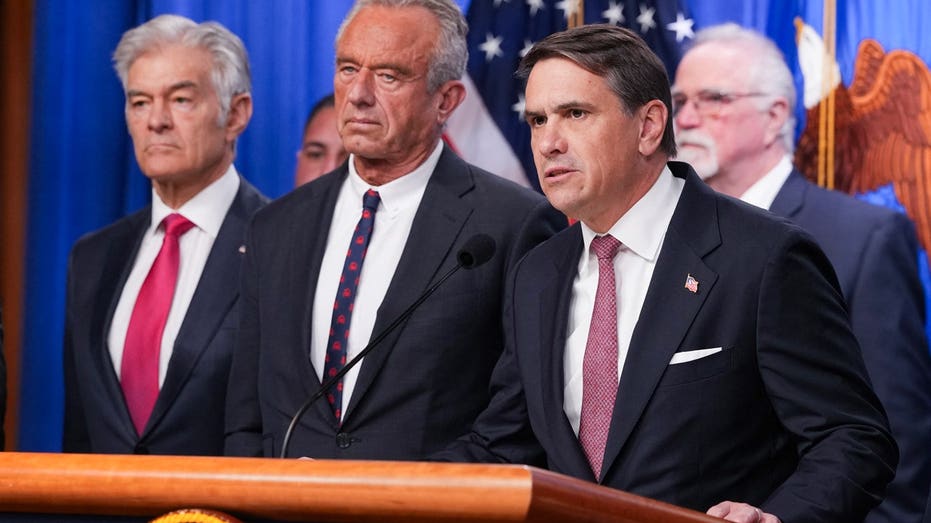

A nationwide business-aid fraud crackdown â highlighted by a bizarre Missouri scheme involving alleged stolen corporate identity â is among the enforcement actions being highlighted during the federal push dubbed “Fraud Week.”
The announcement is part of the Department of Justice’s National Fraud Enforcement Division’s nationwide summer surge. It netted more than 160 criminal defendants and approximately $245 million in intended losses to taxpayers, according to DOJ, as the agency announced busts from Los Angeles to Philadelphia.
“This is the problem of our day,” said U.S. Attorney Matt Price of the Western District of Missouri, whose office was one of 44 involved in the greater “Heartland Fraud Surge” that encompassed June through Sept. 1. “And this is a response to what happened over the previous four years,”
WHITE HOUSE PUSHES ‘WATERSHED’ FRAUD-FIGHTING REFORM IN CONGRESS AS VANCE CONVENES TASK FORCE
“After 9/11, there was a huge lean-in, [an] all-of-government approach to national security issues,” Price said, comparing the Bush-era interagency pivot to terror threats with the coordinated response to the current push against fraud in taxpayer-funded programs.
Price headlined the extensive Small Business Administration (SBA) and COVID-19-related fraud probes under division chief Colin McDonald.
In the “Fur Lives Matter” case, a Missouri man allegedly claimed to operate 19 separate businesses, including some focused on pet care like “Fur Lives Matter,” “Fur Lives Matter LLC,” “Chows & Pals” and “Gods Chow Chow.”
There was one glaring problem: “Fur Lives Matter” was a real company in another state â and prosecutors say it had no connection to Gray.
Using “Fur Lives Matter” and the other purported companies, Jamie Gray allegedly sought to fraudulently obtain nearly $56 million in Paycheck Protection (PPP) and Economic Injury Disaster (EIDL) funds from the Small Business Administration through 29 applications.
Most cases involved entirely fictitious businesses, and only “Fur Lives Matter” was operational at the Feb. 15, 2020, eligibility cutoff.
“Gray effectively stole this companys identity,” the DOJ said in a statement, alleging the legitimate business had no knowledge of him and that his claims about ownership, employees, revenue and operations were fabricated. Gray nevertheless received about $820,000 in SBA funds, prosecutors said.
The case stood out even among a summer surge of alleged fraud schemes for its unusual details.
JUDGE SENTENCES FEEDING OUR FUTURE FRAUDSTERS WHO FAKED RUNNING CHILD NUTRITION SITE
“If you screwed the American taxpayer, the federal government is now going to say you’re cut off, no more,” V